 |
 |
||||||||
 |
 |
 |
 |
 |
 |
 |
 |
 |
 |
|
|
||||||||
|
|
|
|
|
|
|
|
|
|
Related Links
Light Rail Now! can be contacted at: Light Rail Now! |
With Rail Leading, America's Transit Ridership Soars – But After Years of Underfunding, Agencies Plunge Into Crisis Light Rail Now Project Team • August 2008 The good news: In the midst of skyrocketing motor fuel prices, America's public transit systems are seeing ridership soar to record levels. The bad news: In the midst of skyrocketing motor fuel prices – and years of underfunding, especially by the George W. Bush administration – America's public transit systems are facing a deepening financial crisis. Transit's whopping success is unequivocal. In early June, the American Public Transportation Association (APTA) reported that travellers in the USA took more than 2.6 billion trips on public transportation in the first three months of this year – nearly 88 million more trips than last year over the same time period. "ThereÃs no doubt that the high gas prices are motivating people to change their travel behavior" affirmed APTA president Bill Millar. "More and more people have decided that taking public transportation is the quickest way to beat the high gas prices." In 2007, 10.3 billion trips were taken on US public transportation – the highest number of trips taken in fifty years, according to APTA. In the first quarter of this year, public transportation ridership continued to climb, rising by 3.4 percent. "In contrast," APTA pointed out, "the Federal Highway Administration has reported that the vehicle miles traveled on our nationÃs roads declined by 2.3 percent in the first quarter. As APTA's data make clear, rail transit is by far the star performer in this success story. Light rail: highest rate of ridership increase APTA reports that "Light rail (modern streetcars, trolleys, and heritage trolleys) had the highest percentage of ridership increase among all modes, with a double digit 10.3 percent increase for the first quarter."
APTA also notes that several light rail transit (LRT) systems showed double-digit increases, including:
In addition, APTA notes, "New Orleansà light rail [heritage streetcar] system is recovering from Hurricane Katrina with a 476% increase in ridership." Regional passenger rail: second-highest increase Regional passenger rail (RPR, widely called "commuter rail"), according to APTA, came through with the nation's second-largest ridership increase rate at 5.7 percent. Six RPR systems registered a double-digit ridership growth rate in the first three months of 2008:
Rail rapid transit: third-highest increase Rail rapid transit (RRT, also called "heavy rail", consisting of grade-separated subways and elevated train systems) also exhibited a very healthy ridership increase of 4.4 percent, with particularly sharp increases registered in a number of cities:
Bus services also showed increased ridership As APTA reports, public transit experienced gains across the modal spectrum – with even basic bus ridership seeing an increase of 2.2 percent nationwide. "Bus travel in all size communities saw ridership increases; communities with a population of less than 100,000 had a 7.8% increase" notes APTA. Systems with large bus fleets showing the highest increases included:
Darkness at noon With ridership soaring and public transport being hailed repeatedly by the news media and some national leaders as the potential savior of the nation, you'd think America's public transit systems would be reaping the fruits of success, being rewarded with increased funding to enable upgrades and expansions and thus build on proven success. Well, think again. "High gas prices are really a double-edge sword" APTA spokeswoman Virginia Miller told the Christian Science Monitor in a recent article (July 18th). "While they are bringing more people to ride buses and trains all across the country, public transit agencies are facing challenges to meet their costs" she warned. As the Monitor spelled it out,
The situation has been echoed in other media reports – by NBC, for example, in a June 11th story titled "Jammed transit systems running on fumes – Underfunded buses, subways, trains strand some passengers by the wayside". In effect, it's a "Darkness at Noon" situation – a dark crisis looming precisely when transit agencies should be basking in the noonday brightness of supposed victory in the efforts to reverse the decades-long exodus of riders. As NBC relates,
The crisis rippling through the transit industry is being manifested in a spate of problems, and affecting systems in every size category. Ultra-large systems such as Washington, DC, for example, have been struggling with revenue shortfalls, and raising fares in response. Relatively huge rail rapid transit systems in Chicago, Boston, and New York City, facing shortages of cash to upgrade capacity, are now planning seatless cars, into which they expect to cram more passengers as standees, thus yielding heavier loads with densely packed trains (derisively regarded among transit advocates as the "cattle car" approach). Los Angeles, unable to adequately enforce Passenger Proof of Purchase fare collection, is in the process of installing turnstiles at its metro and LRT stations, in a somewhat desperate and dubious (and expensive) effort to try to capture more revenue. Major intermediate-sized systems, such as those in Sacramento, Austin, and Pittsburgh are also being forced to institute fare increases and service reductions in response to revenue shortfalls. The transit industry's crisis is in part, of course, the product of the steep increases in petroleum prices that have spiked the cost of diesel fuel. In addition, global market pressures have sent other costs skyrocketing, such as those of major construction materials such as steel; and cement. Compounding the effects of these crises, the collapse within America's mortgage and credit market has resulted in a severe economic downturn, leading to a plunge in local tax revenues essential to supporting transit operations as well as other essential services (such as roadway maintenance). Transit operations are thus caught in a kind of pincers, between skyrocketing costs, especially in diesel fuel, and plunging public revenues as a result of the souring economy. However, some of these economic dislocations were readily predictable and could have been anticipated – indeed, they have been predicted by some analysts within the transportation industry, but their warnings unfortunately have consistently bounced off deaf (or insensitive) ears. State & federal hostility toward public transport Particular responsibility for the current crisis would seem to accrue to a government-based policy of deliberate neglect and outright hostility toward public transport, exhibited for years by both state and federal levels of government, and civic institutions (such as universities) that should know better. Even in large states such as Texas, California, and Florida, lawmakers have cut, rather than increased, funding for public transport – or taken other measures to weaken it. (In Austin, Texas, for example, the administration of Gov. Rick Perry is forcing the transit system to abandon its major downtown interchange hub near the State Capitol grounds – a facility that has provided convenient transfers among major routes for well over a century. See: State of Texas to Austin transit: Get lost. In California, Gov. Arnold Schwarzennegger has thrown major transit systems into financial crisis, and stalled crucial projects, by diverting "dedicated" transit tax revenues to fill other budgetary shortfalls.) In some major states, such as Missouri, Minnesota, and Wisconsin, efforts to aid public transportation have been repeatedly roadblocked by transit opponents. In several cases, important rail transit projects have been blocked or resisted by other public agencies, such as airports, government departments, or universities, on pretexts ranging from "security" concerns to objections about "unsightliness" or the perceived inconveniences of transit power systems, tracks, stations, or park & ride facilities. And in some areas, highly acclaimed transit systems are under direct attack from legislators – such as Salt Lake City's TRAX LRT system, which, despite its phenomenal success in attracting ridership from roadways and improving transit's cost-effectiveness, has been the target of fierce criticism from some state legislators, in an effort aimed at reallocating transit-dedicated tax revenues into roadbuilding. But by far the most damage has emanated from the Bush administration's Department of Transportation (DOT) and its agencies dealing with public transport – especially the Federal Transit Administration (FTA) and Federal Railroad Administration (FRA). For years, the DOT, FTA, and FRA have systematically constrained, crimped, and weakened funding programs, imposed increasingly bureaucratic constraints, and introduced increasingly severe regulatory constraints. Such constraints have relentlessly increased costs, reduced flexibility, and dimished the flow of available funding. Constrictions on federal capital funding have forced many transit agencies to pay for essential capital improvements on their own – diverting money out of the same pot of revenue that they use to supplement operations and maintenance expenses. "DIY" transit funding = "Drop Dead" This situation was highlighted at a recent "Transit Summit" in St. Louis, including a presentation from Federal Transit Administration head James Simpson. While the meeting was focused on a campaign to secure more solid funding for St. Louis's transit system, the message that emerged, as reported by the St. Louis Post-Dispatch (August 5th), would seem to encapsulate the hard reality of policy that currently prevails in the Bush administration as well as in numerous state leislatures throughout the USA:
"Federal and state governments were said to be out of the transit business" ... This policy message – which can be more or less translated "Government to transit: Drop dead" – is difficult to characterize with available adjectives. In the context of today's multiple crises, with motor fuel prices streaking toward the outer fringes of the galaxy, labels such as "outrageous", "absurd", "reprehensible" seem too mild; "irresponsible" and "obscene" would seem a bit more appropriate to the situation. Much of the Bush DOT's efforts seems aimed at privatizing the entire transportation system – particularly the agency's emphasis on constructing tollways, imposing toll charges on existing roads, eliminating motor-fuel taxes (as a means of public support for transportation facilities and services), requiring "public-private partnerships" for major transit projects, and shifting from a system of criteria-based grant funding to competitive bidding for funds by transit agencies forced to compete with one another. In this context, the "privatization" program seems enmeshed with a basic goal of deconstructing America's public transport services altogether. (And hasn't the USA already "Been There, Done That"? Didn't the transit "privatization" model basically collapse in the Transit Holocaust of the 1930s-60s? For more on this issue, see our article Bush DOT's privatization & motorization scheme = "Been There, Done That".) This apparent aim of "deconstructing" public transport seems corroborated by other policies in the DOT mix. Astoundingly, Bush's DOT has taken dramatic measures to promote motor-vehicle transportation just as the Peak Oil crisis has begun to be felt. For virtually its entire tenure, the Bush DOT has encouraged transit agencies to replace LRT plans with schemes for "BRT" ("Bus Rapid Transit") – a catch-all term used to repackage virtually any upgrade in bus service as a new "fixed-guideway" operation. The net result has been to discourage electric transport development and foster greater dependency on petroleum-fueled buses – thus contributing to today's diesel-cost crisis. Particularly as the Bush government has neared its end, this ideological shift toward emphasis on privatization and motor vehicle mobility has intensified. DOT policy initiatives just within the past 11 months have included the following:
These policy initiatives and proposals represent just some of the more egregious of the efforts of anti-transit ideologues and policymakers entwined in the outgoing Bush administration. Clearly, from the data presented above, public transportation is succeeding in its mission, and has repeatedly shown its potential to provide a viable mobility alternative, particularly in a period of major national dislocations. It would seem equally clear that critical policy changes are essential to support these trends and bolster this potential – changes dramatically different, and more favorable to public transport, than the highway and private-profit-focused approaches of the current lame-duck DOT. Certainly, in this season of political change, public transportation advocates and professionals have an opportunity to help more progressive, public-transport-focused changes materialize. Light Rail Now! website URL: http://www.lightrailnow.org/news/n_lrt_2008-08a.htm Updated 2008/08/06 | ||
|
|
|||





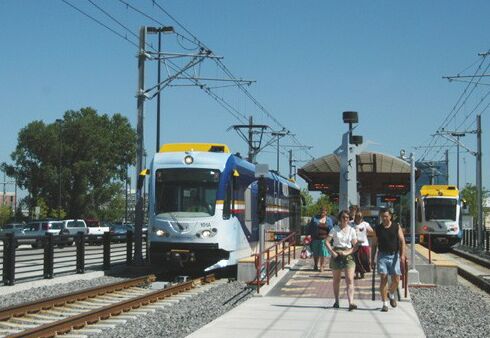 Light rail transit (LRT) led America's public transportation in ridership growth rate, and Minneapolis's Hiawatha LRT line was one of the star performers,
with a growth rate of over 16%.
Here, passengers deboard a train at the 28th Ave. station.
Light rail transit (LRT) led America's public transportation in ridership growth rate, and Minneapolis's Hiawatha LRT line was one of the star performers,
with a growth rate of over 16%.
Here, passengers deboard a train at the 28th Ave. station.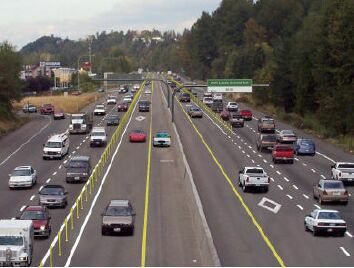 Bush government's Department of Transportation would shift policy emphasis away from public transport and electrified transit systems
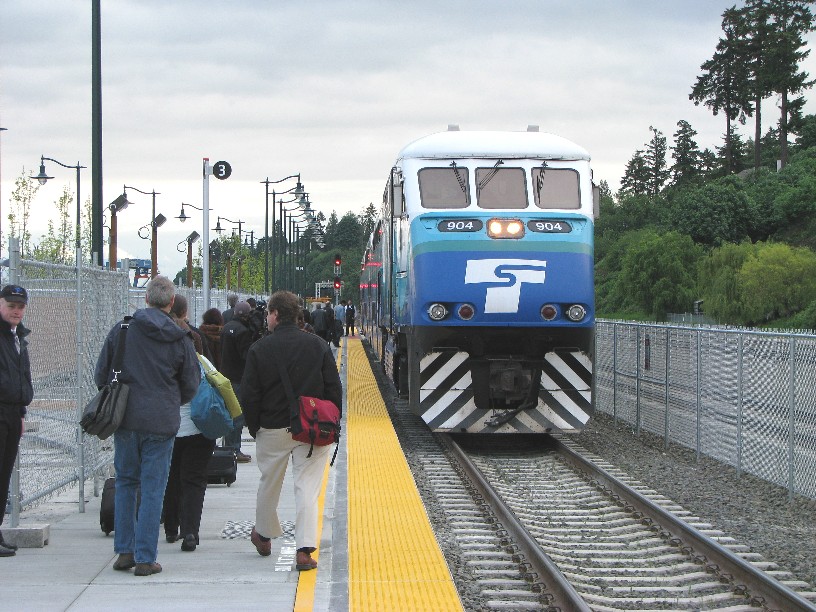
in favor of tollways and privately funded transportation, particularly for motor vehicles – such as this High-Occupancy Tollway (HOT) facility proposed for the Seattle area,
which DOT policymakers would redefine as a "fixed-guideway" system, competing for funds with rail transit.
Bush government's Department of Transportation would shift policy emphasis away from public transport and electrified transit systems
in favor of tollways and privately funded transportation, particularly for motor vehicles – such as this High-Occupancy Tollway (HOT) facility proposed for the Seattle area,
which DOT policymakers would redefine as a "fixed-guideway" system, competing for funds with rail transit.